Learning & behavioural data points
Informing how we understand learners and personalize support.
Better learning outcomes.
Up to 10× faster.Powered by Parentof’s evidence-based cognitive intelligence.
Performance goal: 10× faster learning is an ambition, not an established result across products. Explore the current evidence ↗
Built since 2015 · Data Science + Cognitive Sciences
The foundation to understand human potential.
Informing how we understand learners and personalize support.
50,000+ longitudinal users
Understanding development and change over time.
Building the ARRC foundation since 2015.
14th Aegis Graham Bell Awards · 2024
Explore our recognition ↗Digital learning has expanded what children can access. Yet access to lessons is only one part of learning. A child also needs to focus, hold ideas in mind, manage frustration, and keep trying.
The latest PISA results show that reading and mathematics performance continued to decline between 2022 and 2025.
Change in mean performance across 35 OECD countries. PISA 2025 results published 8 September 2026. These trends do not isolate the effect of educational technology. Source: OECD PISA 2025 ↗
That is the question at the heart of Parentof. We shifted the focus from teaching more content to developing the abilities children use to learn. Developmental science helps us understand the need. Data and AI help personalize the practice. Progress tells us what to refine.
See the thinking behind personalized ability development.
The wider evidence: UNESCO’s 2023 Global Education Monitoring Report calls for technology to serve learners and notes that impartial evidence of educational impact remains limited. Read UNESCO’s perspective ↗
Family development, student support, school operations, and specialized AI mentors—each with a distinct role.

FUMI is an AI companion helping children turn passive screen time into stronger focus, self-control and learning—through ten minutes of personalised play a day.
2× focus is our development goal; individual progress varies. Explore the attention research ↗
Explore FUMI ↗ Focus · Self-regulation · Learning readiness

SafeMango connects classroom signals to educator-approved neuroplay—helping students build the focus, self-regulation, and cognitive skills that learning depends on.
50% reduction is our development goal. Individual progress varies.

PupilPod is a cloud education management platform connecting admissions, academics, fees, campus operations, and the people around every learner.
Product research and roadmap directions built around the abilities behind drawing, handwriting, and mathematical thinking.
 RESEARCH PRODUCT
Improve your fine motor skills and deliver 3× better drawings.
32.3% growth in the combined-intervention study group.
Explore the approach ↗ RESEARCH PRODUCT
Go beyond four-line practice books with guidance tailored to every stroke.
22% legibility growth in the combined study group.
Explore the approach ↗ ROADMAP
In development. Product-specific efficacy evaluation is a next step.
Explore the approach ↗
The parent-guidance product at the roots of our personalized development journey.
Explore MAI ↗ARRC Engine
Our AI mentors personalize each learning journey—using evidence-based insights to build the abilities that drive better outcomes.
Science, simply explained ↗
NIMHANS reviews examine the assessment and recommendation models behind ARRC.
Explore the 2017 assessment review ↗| In this study | ARRC AI | Child Psychologist |
|---|---|---|
| Recommendation turnaround | <20 sec | 2 days |
| Parameters per recommendation | 30+ | 3–4 |
Personalization across frequency, intensity, speed and time.
Explore the full comparison ↗A comparison of developmental activity recommendations in a specific exploratory study—not a measure of diagnostic or treatment superiority.
Read what each study measured, what changed, and what the findings support.
Expert-recorded sustained attention increased by an average of 124.3% after three months in 85 children.
85 children · 3 months · Pre–post studyRead the evidence ↗Combined developmental activities and drawing practice produced 32.3% growth, versus 23.8% with practice alone.
15 children / 3 groups · Four intervention days per drawing cycle · Experimental pre–postRead the evidence ↗Legibility improved by 22% in the combined group, compared with 11% for practice alone and 3% for developmental activities alone.
14 children / 3 groups · 6 weeks · Experimental pre–postRead the evidence ↗Findings are specific to the studied intervention, group, and measure. They are not directly comparable or guarantees of individual outcomes.
The platform combines developmental knowledge, longitudinal histories, expert input, and learning workflows. Its value depends on turning that foundation into useful, measurable outcomes.
A company-reported framework spanning 1,500+ micro-abilities across developmental domains.
Observations and records that capture how needs, practice, and performance change.
Assessment structures, skill taxonomies, activity libraries, and recommendation logic.
Products that reach families and schools, with opportunities for partner distribution.
Platform coverage and repository figures are company-reported; each impact study has its own participant sample.
We bring together industry leaders, policymakers, healthcare professionals, educators, and government stakeholders to advance responsible AI, developmental science, and better learning outcomes.


Winner, Innovation in Education, at the 14th Aegis Graham Bell Awards.
Recognition for Parentof’s approach to developing the abilities behind learning.
View the official winners ↗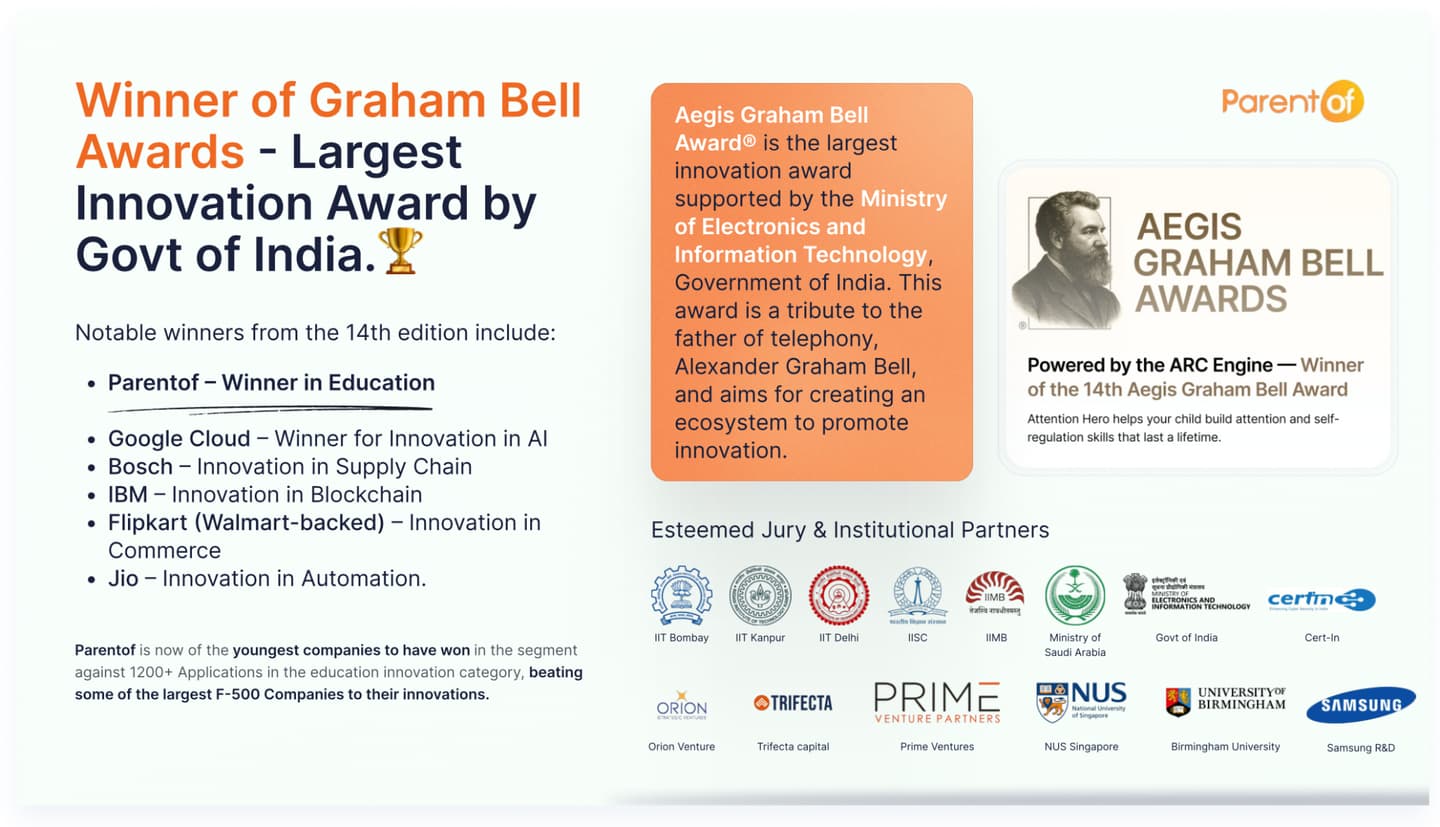
Explore the stories behind Parentof, MAI, and our approach to personalised development.






Connect with Parentof about a product, partnership, research, or investment conversation.